

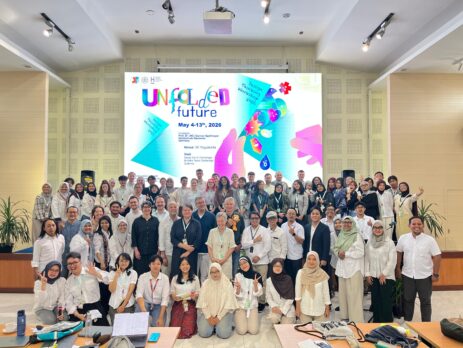
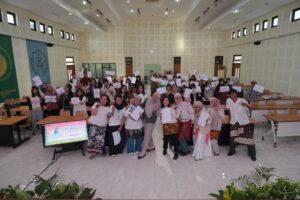
Bantul, May 4, 2026 — Institut Seni Indonesia (ISI) Yogyakarta, in partnership with Hochschule Hannover University of Applied Sciences and Arts, Germany, inaugurated the Design Thinking Workshop 2026 themed “Unfolded Future.” Held at the Ajiyasa Building, Faculty of Fine Arts and Design, the program continues a sustained academic collaboration established in 2014.
Conducted over eight days (May 4–8 and 11–13, 2026), the workshop integrates participants from multiple disciplines and professional backgrounds, including academics, practitioners, social organizations, and orphanage stakeholders. The inclusion of undergraduate and postgraduate participants fosters a multi-layered learning environment that encourages critical dialogue and knowledge exchange. The workshop is facilitated by Prof. Dr. (HC) Gunnar Spellmeyer and his academic team from Hochschule Hannover.
The theme “Unfolded Future” reflects a conceptual stance that views the future of children—particularly those in orphanage environments—as dynamic and shaped through intervention, empathy, and collaborative engagement. The workshop positions orphanages as complex socio-cultural ecosystems with significant potential for design-driven transformation.
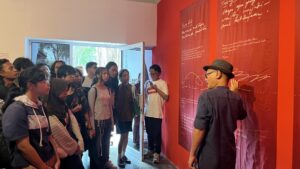
Through the design thinking framework, participants engage in iterative processes encompassing empathy, problem framing, ideation, prototyping, and evaluation. The methodology emphasizes field immersion, enabling participants to directly observe and interact with children in orphanages, thereby grounding design responses in lived experiences and contextual realities.
Institutional representatives highlighted the broader implications of the workshop. Muhamad Sholahuddin underscored the role of design as an agent of social responsiveness and sustainability, while Dr. Dewanto Sukistono emphasized interdisciplinary collaboration as a critical approach to addressing complex societal challenges.
Additionally, the workshop incorporates industry perspectives through a session by Aria Sungsang Nir Prahara, examining the transition from handcrafted production to scalable manufacturing systems. This contribution bridges conceptual design thinking with practical production strategies.
Ultimately, the workshop is envisioned not merely as a platform for generating design outputs, but as a reflective and inclusive learning ecosystem. It aims to cultivate long-term awareness, empathy, and collaborative capacity in addressing social issues through design, while opening pathways for sustained international cooperation.
Author: Public Relations Team of Interior Design Study Program

 ID
ID  EN
EN